July 10, 2023

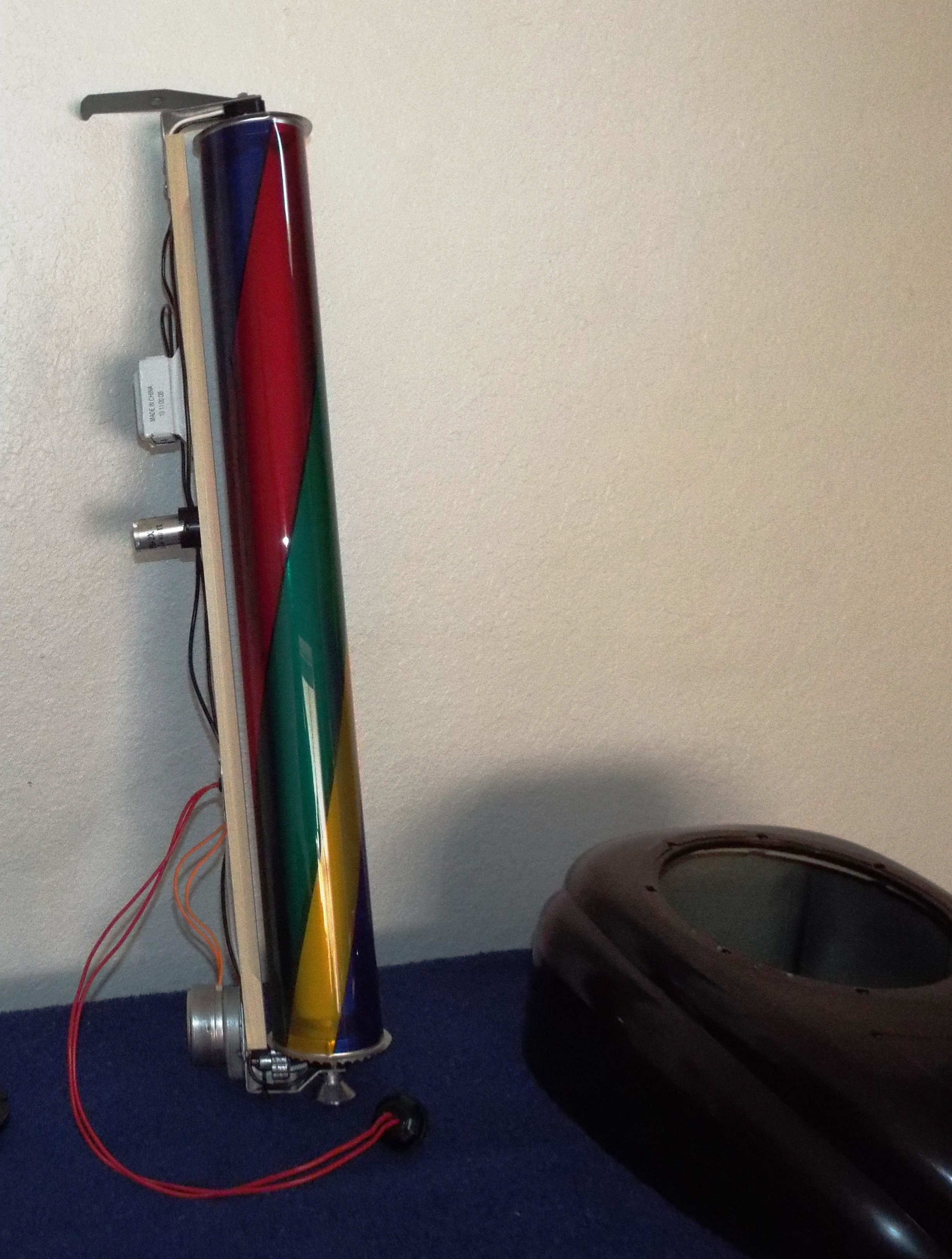
The New G has a C style pilaster conversion with colored animation. I really like this treatment. Coupled with translucent pilasters it really tricks a G up. Back in the 90’s we used Fred Mlakar’s animation units. He made these for many makes not just Seeburg. These are self-contained light sticks with an animation motor and a color cylinder that popped in place neatly between the caster stud and a slide-in wood plate. The gears fell off the motors in the New G. I really didn’t understand how they were originally attached. Something fell out but I didn’t know what it was. The motor shaft is very thin at 1/8″ and the gear hole is easily 3/16″ maybe 1/4″. I thought of very carefully drilling and threading holes for set screws or perhaps epoxying them on.

Then I got the idea to call the man himself. I had tracked Fred down about five months ago to see if he was still making these animation units. He’s not. He can’t get the correct motors anymore. But, he had two left and was willing to sell them to me. I’ll use them for a 100C coming up someday. I explained my problem and solutions to Fred and he told me what he does. He does not use set screws; tried those; they’re noisy and vibration is transmitted through the cabinet and can affect the sound. What he does or did was quite unique and he had special tooling made to be able to install a rubber sleeve made of surgical tubing into the gear shaft hole and then what he called a D spring into the rubber sleeve. The D piece fits tightly over the moter shaft mating with the flat side. You might have seen these type of “springs” on any number of press fitted knobs. Fred said he still had the tooling and to send the gears to him and he would repair them. This was extremely generous of him and sure got me out of a jam. I imagine he was curious to see them as well. It had only been 30 some years. They will be in the mail tomorrow without fail.

The SMC1 amplifier, a SHP3, got recapped the night before and now was time to bench test.It had no burned resistors or bad transistors. Very straightforward refurb. I cleaned the bias pots, set bias and fired it up. Very weak left channel that I tracked down to a loose connection on the pre-amp board. Once that was fixed I ran it for awhile keeping an eye on the bias. It was rock solid-didn’t wander. Put it in the SMC1. I’ve written very little about the SMC1. The mech has already been washed and serviced. I’ve got a good MCU for it. The PCC and the MCU were tested in another SMC. With the amp done it’s time to test it. I seem to be attracting them lately. I have another SMC1 and a SMC2 in the wings.

Got my Victory Glass order. This always feels like Christmas. The premier piece was the SMC2 bottom glass. This is a new piece for Victory and it is a stunner. After the SMC1 is done then it’s on to the SMC2. I also ordered mech cover inserts for the G and the upcoming C plus classification sets, selection indicator strips,record rack number strips, a back door decal set, some motor couplers, Nidec motor mount conversion rings, and a couple of stripper plates one of them complete. I could not believe the crappy finish on the brush holders for one of the stripper plates. I’ve seen 50 year old originals that looked better. Called Jim at VG and he asked for pictures. Took a few and sent them. Got a call back, yep they were pretty bad. He’s sending another set. Victory will take care of you and I trust them. I found out they finally made some C pilasters and was able to order a set of the white translucent ones. Poor guys, I had only been bugging them for a couple months.

July 7, 2023

I pulled the amp out of the New G to bench test. I got a surprise when I turned it over to inspect. It had one of my stickers on it from 1998. I remember getting those stickers. I ordered the return label stickers from some outfit and used the three lines for a cheap custom sticker. This is while I was in business for myself at the Seagoville shop. I did a lot of BeBop’s jukeboxes. I’d usually do the backdoor electronics consisting of the amplifier and selection reciever, the electrical selector or push button assembly, and the pinbank.

I pulled the tubes and they tested good. I ran the amp without the AVC tubes, the 6SK7 and 6SL7. I rarely use those. Not really needed with the advances in record pressing in later years. Mounted the amp on the bench and fired it up. Great sound. Gratifying to see a 30+ year cap job still doing its duty.

I took a break this morning to go to my favorite glass company, Country Glass, right here in Mesquite to get a glass cut for the DEC wallbox I had recently received through ebay. It is complete, looks good, and I plan on using it with the SMC2 coming up. However when I got it I discovered no front glass! The seller was cool about it and admitted he listed items but didn’t always see them and refunded $25 back to me. This was enough to pay for the glass. Country Glass is quick and very reasonable and had it cut by lunch. I spent about 30 minutes getting it mounted plus remounting the glass I had pulled from another DEC for a pattern.

In the evening I finished the New G pinbank I had started the evening before. I like to get off the couch about 9pm and do an hour or so of work before bed. The pinbank had a bad burn spot at A7 underneath on the metal frame. That coupled with the very badly burned contact pin had me worried. I’ve never seen one of these burned much less as badly as it was. It’s like the mech got stuck at A7 and arc welding commenced. Earlier in the day I had put out a request for a replacement contact pin on The Seeburg Jukebox Collector site on FB. My buddy Dan P. from California came through for me and it was quite a relief. I did not think I would find one of these very easily.It’s on its way.

It’s not unusual to have one or even several burned selection coils in the pinbank. I expected this one to have at least a couple. However, I opened the bottom of this little beauty up and no burned coils! Someone had replaced the pinbank but kept the original bottom frame with its burn spot. All 100 coils looked good and this is always a relief. Still very worried. What caused that burnt contact pin? The electrical selector would get a close inspection when its time came. The proof of the pinbank being replaced was the willy nilly assembly of the selection pins and the contact plates. These all go a certain way. They are all stamped pieces and if you look closely it’s easy to tell which are the stamped sides. The rounded side of the lever goes toward the coil. Because of stamping the squarish contact washers have a side with edges which goes down. An easy way to tell is to look at the notch-it isn’t centered and the “little” end goes to the right. These need no added friction. I found this out the hard way.

I have restored/shopped out/refurbished/ whatever ya call it more than my share of pinball machines. Usually the springs especially on the electromechanicals get a little weak and it was my habit to give them a little stretch here and there as needed. My first pinbank it sure seemed the springs under the levers were somewhat collapsed and weak. So I gave all 100 a little stretch and assembled the pinbank. I use an old Gottlieb pinball transformer for 25 volts AC with a couple of old test leads to bench test the pinbank coils. None of the individual levers would move. The “little stretch” I gave the springs was just enough added friction that the small coils couldn’t pull the pins. I had parts pinbanks and quickly replaced all the springs I had stretched. So, since then I have been very vigilant about added friction in a pinbank.

After assembling the pinback I broke out the old Gottlieb transformer and leads and quickly tested the five group plate magnets and all 100 of the selection coils. The smell of ozone wafted up as I hit each conact with my leads and listenened for the click as the coils pulled each of their levers. The group coils are unmistakably loud as they pull in. Electromagnetism at work. All is good.